
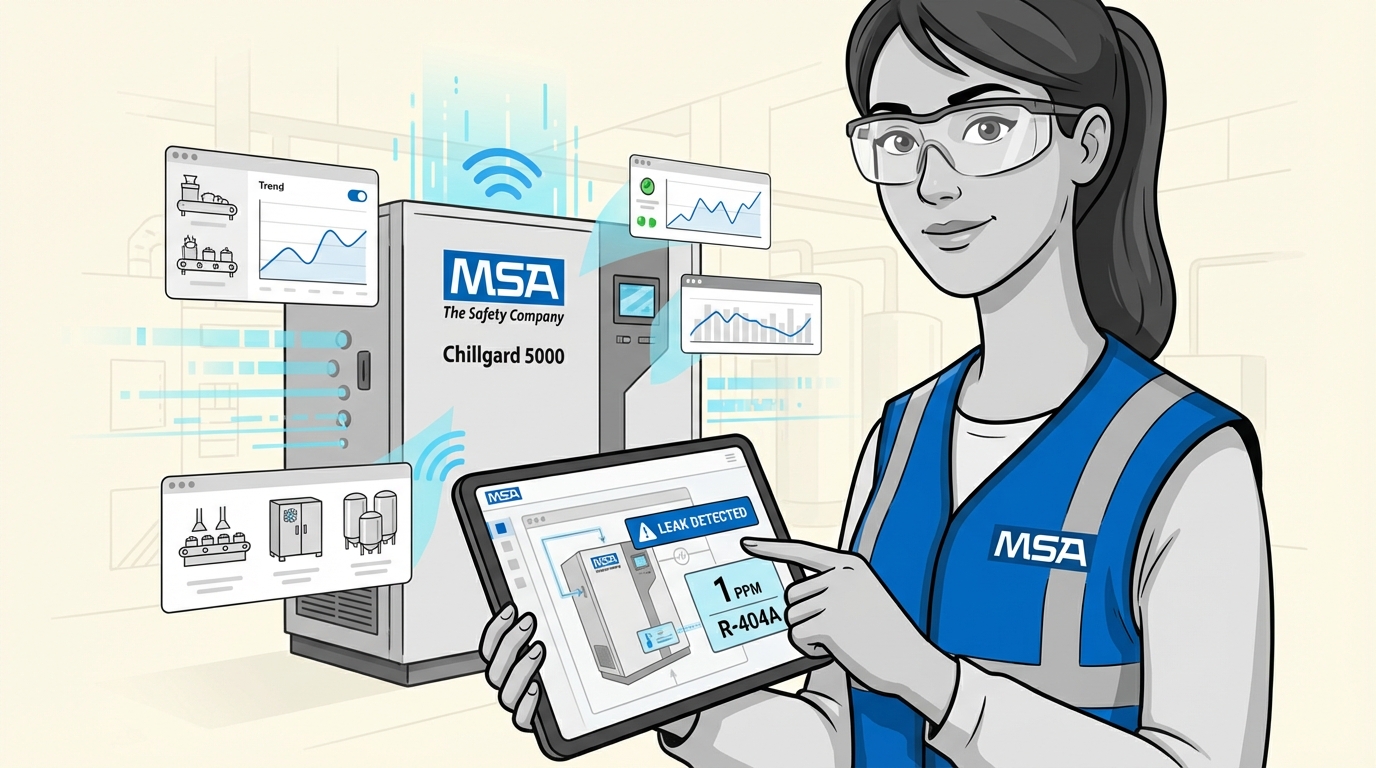
If you’re running a food or beverage plant in Queensland, you’ve got enough to worry about without chasing down refrigerant leaks. Yet those leaks cost you money every day they go undetected. Not just the cost of the refrigerant itself, but the inefficiency in your systems, the potential compliance issues, and the safety risks to your staff.
The MSA Chillgard 5000 is a refrigerant leak monitor that detects leaks at 1 part per million. That’s early enough to catch problems before they become expensive headaches.
At Endless Process Automation, we’re the Queensland distribution partner for MSA. We’ve installed Chillgard systems across food processing plants, cold storage facilities, and beverage production lines throughout the state. Here’s what you need to know about whether this system makes sense for your operation.
Why refrigerant leaks matter in food & beverage
Refrigeration is the backbone of food and beverage production. From blast freezers to cold storage rooms to processing line chillers, you rely on these systems running 24/7. When refrigerant leaks, the problems stack up quickly.
The cost of lost refrigerant
Refrigerant is not cheap. R-404A, R-410A, and ammonia prices have all increased significantly in recent years. A slow leak in a large industrial system can bleed off hundreds of kilograms of refrigerant annually. At current prices, that’s thousands of dollars literally vanishing into the atmosphere.
Beyond the direct cost, leaks make your compressors work harder. An undercharged system runs less efficiently, driving up your power bills. In Queensland’s climate, where ambient temperatures already stress refrigeration equipment, you cannot afford that extra load.
Safety risks in cold storage and processing areas
Refrigerant gases can displace oxygen in enclosed spaces. In mechanical equipment rooms and cold storage areas, this creates a real asphyxiation risk for your maintenance staff. Some refrigerants, particularly ammonia (R-717) commonly used in large industrial food plants, are toxic at concentrations well below what you can smell.
The Chillgard 5000 meets ASHRAE 15 requirements by providing visual and audible alarms both inside and outside mechanical equipment rooms. It can also activate mechanical ventilation automatically when leaks are detected.
Queensland climate challenges
Queensland’s heat and humidity are brutal on refrigeration equipment. Compressors run harder, seals degrade faster, and vibration takes its toll on pipework. Gladstone’s humidity, the Bowen Basin’s dust, and Brisbane’s summer heat all create conditions where leaks are more likely to develop.
Your gas detection system needs to handle these conditions without false alarms or drift. The Chillgard 5000’s PAIR technology handles this better than electrochemical alternatives.
How the Chillgard 5000 works
The Chillgard 5000 is an aspirated gas detection system. It draws air samples from multiple points throughout your facility through tubing, analyzes them for refrigerant concentration, and triggers alarms when thresholds are exceeded.
Photoacoustic Infrared (PAIR) technology explained
Traditional electrochemical sensors work by reacting the target gas with chemicals in the sensor. This consumes the chemical medium over time, leading to drift and the need for frequent recalibration. They’re also susceptible to interference from other gases and changes in temperature and humidity.
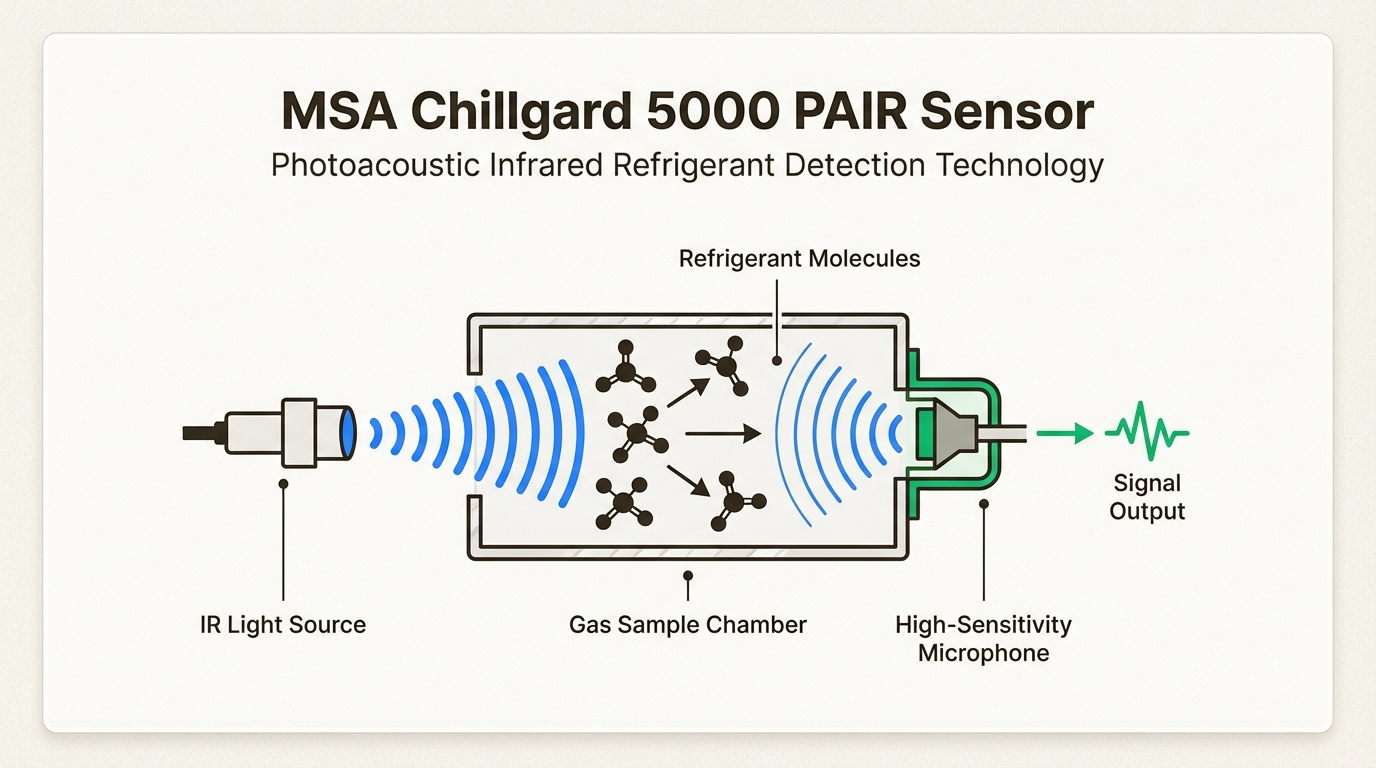
The Chillgard 5000 uses patented Photoacoustic Infrared (PAIR) technology. It works by shining infrared light through the sample at a wavelength specific to the refrigerant being detected. When refrigerant molecules absorb this light, they heat up and expand. This creates a pressure wave that a sensitive microphone detects.
The advantages are significant:
- Minimal drift: The sensor is not consuming chemicals, so baseline readings stay stable for months
- Immune to interferents: Cleaning agents and solvents that throw off electrochemical sensors don’t affect PAIR
- Temperature and humidity stability: Queensland’s climate swings don’t impact accuracy
- Lower maintenance: Fewer calibrations mean less downtime and lower lifecycle costs
1 ppm sensitivity in practice
The Chillgard 5000 detects leaks as low as 1 part per million for most refrigerants. For ammonia, the dedicated Chillgard 5000 Ammonia Monitor variant detects at 10 ppm. To put that in perspective, 1 ppm is roughly equivalent to detecting a teaspoon of refrigerant in a standard shipping container.
This sensitivity matters because refrigerant leaks don’t start as gushers. They start as slow seepages from a flange, a micro-crack in a weld, or a degrading seal. Catching these early means you can schedule repairs during planned maintenance windows rather than emergency shutdowns during production.
Multi-refrigerant monitoring
Food and beverage plants often run mixed refrigerant systems. Your blast freezers might use R-404A while your process chillers run R-410A or ammonia. The Chillgard 5000 monitors up to 6 refrigerants simultaneously from a library of over 38 options.
The refrigerant library includes:
- Common HFCs: R-134a, R-404A, R-407C, R-410A, R-507A
- Low-GWP alternatives: R-448A, R-449A, R-452B, R-513A, R-515B
- Ammonia: R-717 (requires ammonia-specific variant)
- Fire suppression: R-227ea (FM-200)
Selection is field-programmable through the touchscreen interface. If you change refrigerants during a system upgrade, you reconfigure the monitor rather than replace it.
System configuration options
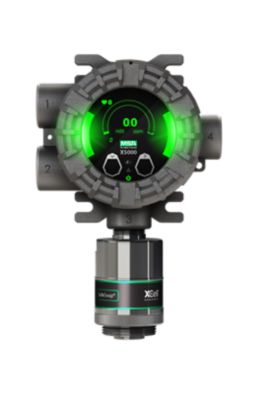
The Chillgard 5000 scales to fit your facility. Whether you’re running a small cold store or a multi-zone processing plant, there’s a configuration that matches.
Sample point configurations
| Configuration | Sample Points | Typical Application |
|---|---|---|
| 4-Point | 4 | Small cold rooms, individual compressors |
| 8-Point | 8 | Medium cold storage, multiple zones |
| 16-Point | 16 | Large industrial plants, extensive pipework |
Each sample point is a tubing inlet that draws air from a specific location. Common placement points include:
- Compressor room ceiling (refrigerant is heavier than air)
- Low points in pipe runs
- Evaporator outlets
- Cold storage room returns
- Equipment room entryways
The sampling system uses a pump to draw air through the tubing to the central analyzer. Tubing runs can extend up to 100 meters per point, giving you flexibility in placing the main unit where it’s accessible for maintenance.
Remote display for entryway safety
ASHRAE 15 requires visual and audible alarms at equipment room entryways. The Chillgard 5000 Remote Display provides a 7-inch touchscreen that mirrors the main unit’s readings. Up to four remote displays can be connected in series.
This gives your staff the “know before you go in” capability. Before entering a mechanical room, they can check refrigerant concentrations, alarm status, and system health from outside. The remote display includes a 70 dB audible alarm and optional strobe for clear warning signals.
Integration with building management systems
The Chillgard 5000 outputs via BACnet, Modbus, and 4-20mA analog signals. This lets you integrate it with your existing building management system or SCADA platform.
Integration capabilities include:
- Real-time concentration data for trending
- Alarm status for safety shutdowns
- Fault diagnostics for maintenance scheduling
- Event logging for compliance records
For cloud connectivity, the optional FieldServer ProtoAir Gateway enables remote monitoring and alerting to mobile devices.

Installation and maintenance considerations
Getting the Chillgard 5000 installed correctly matters. Poor placement of sample points or inadequate tubing runs will give you either false alarms or missed leaks.
Placement strategy for food plants
Refrigerant vapors are heavier than air, so they accumulate at low points. Sample points should target:
- Floor level in compressor rooms
- Below evaporators in cold storage
- Near potential leak points (flanges, valves, seals)
- Entryways for safety compliance
In food processing areas, you also need to consider hygiene. The sampling tubing must not create harborage points or interfere with washdown procedures. We typically specify stainless steel tubing with sealed penetrations in food contact zones.
Calibration and maintenance
The Chillgard 5000 features one-touch calibration through a dedicated port. The system guides the technician through the process on the touchscreen. Calibration gas is injected at a known concentration, and the system adjusts its baseline accordingly.
Predictive maintenance diagnostics monitor sensor performance, pump health, and flow rates. When components approach end-of-life, the system alerts you before failure. This lets you schedule maintenance during planned shutdowns rather than reacting to failures.
Modules are field-replaceable. If a sensor needs replacement, you can swap it in minutes without taking the entire system offline.
Australian compliance requirements
Beyond ASHRAE 15, Australian food facilities must comply with Work Health and Safety regulations and food safety standards. The Chillgard 5000’s event logging and alarm records support compliance documentation.
For ammonia systems, additional requirements under the Work Health and Safety Regulation 2011 apply to refrigerating systems with charge sizes above certain thresholds. The Chillgard 5000 Ammonia Monitor meets ANSI/IIAR and EN 378 standards for these applications.
The Endless Process Automation advantage
We’re not just box-droppers. At Endless Process Automation, we’re engineers first. We’ve done the hard yards in the field before stepping into sales, so you won’t get “yes men.”
Queensland distribution partner for MSA
As the authorized Queensland channel partner for MSA, we carry local stock and provide local support. When you need a Chillgard 5000, we can get it to your site quickly. When you need technical support, you’re dealing with someone who understands Queensland industrial conditions.
Our locations in Narangba, Gladstone, and Mackay put us within reach of most Queensland industrial hubs. We understand the local challenges: Gladstone’s humidity, the Pilbara heat, the Bowen Basin’s dust. We specify equipment that survives here.
For more on our gas detection capabilities, see our MSA fixed gas and flame detection page.
Engineering-first approach
Before we quote a system, we do a site assessment. We look at your refrigeration layout, your existing controls, and your maintenance capabilities. Then we recommend a configuration that actually fits your needs.
If your process doesn’t need a 16-point system, we’ll tell you. If a different MSA solution makes more sense for your application, we’ll suggest it. We’re vendor-neutral within the MSA range, and we also support other brands when they’re the better fit.
Our services include:
- Site assessments and system design
- Installation supervision and commissioning
- Integration with your BMS or SCADA
- Training for your maintenance team
- Ongoing calibration and maintenance support
Making the decision
When should you consider upgrading your refrigerant detection?
- If you’re losing refrigerant and can’t find the source
- If your current detectors require frequent recalibration
- If you’ve had compliance audit findings related to gas detection
- If you’re expanding or upgrading refrigeration equipment
- If you want to reduce maintenance overhead on your safety systems
The Chillgard 5000 is not the cheapest option on the market. US pricing ranges from approximately USD $15,500 for a 4-point system to USD $22,300 for a 16-point system with strobe. But the total cost of ownership over 5-10 years is competitive due to reduced maintenance and longer sensor life.
Contact Endless Process Automation for current Australian pricing and availability. We can provide a site-specific quote that includes the right configuration for your facility.
Need technical advice or a hard-to-find part? Contact Endless Process Automation for a vendor-neutral quote today.
Frequently Asked Questions
What refrigerants can the MSA Chillgard 5000 detect in food and beverage applications?
The Chillgard 5000 monitors over 38 refrigerants commonly used in food and beverage plants, including R-134a, R-404A, R-407C, R-410A, R-507A, and newer low-GWP alternatives like R-448A and R-513A. For ammonia-based industrial refrigeration systems, the dedicated Chillgard 5000 Ammonia Monitor detects R-717 at 10 ppm. You can program up to 6 refrigerants simultaneously through the field-selectable library.
How often does the MSA Chillgard 5000 need calibration in a Queensland food plant?
Thanks to PAIR technology, the Chillgard 5000 requires less frequent calibration than traditional electrochemical sensors. The exact interval depends on your specific application and compliance requirements, but most facilities calibrate every 6-12 months. The system includes predictive maintenance diagnostics that alert you when calibration is actually needed rather than following an arbitrary schedule.
Can the MSA Chillgard 5000 integrate with my existing building management system?
Yes. The Chillgard 5000 outputs via BACnet, Modbus, and 4-20mA analog signals, which covers most building management and SCADA systems. This allows you to trend refrigerant concentrations, log alarm events, and trigger automated ventilation responses through your existing control infrastructure.
What is the difference between the standard Chillgard 5000 and the ammonia monitor variant for food plants?
The standard Chillgard 5000 detects refrigerants at 1 ppm minimum. The Chillgard 5000 Ammonia Monitor is specifically tuned for ammonia (R-717) detection at 10 ppm, which is the appropriate sensitivity level for ammonia’s toxicity characteristics. If your food plant uses ammonia-based industrial refrigeration, you need the ammonia-specific variant.
Does Endless Process Automation provide installation and ongoing support for MSA Chillgard 5000 systems in Queensland?
Yes. As the Queensland distribution partner for MSA, Endless Process Automation provides complete support including site assessment, system design, installation supervision, commissioning, integration with existing controls, maintenance team training, and ongoing calibration services. We have offices in Narangba, Gladstone, and Mackay to support facilities across Queensland.
How many sample points do I need for my food plant’s refrigeration system?
The Chillgard 5000 comes in 4, 8, and 16-point configurations. For small cold storage facilities, 4 points often suffice. Medium-sized processing plants typically need 8 points to cover compressor rooms, cold storage, and processing areas. Large industrial facilities with extensive pipe runs may require the full 16-point configuration. We recommend a site assessment to determine the optimal coverage for your specific layout.