
Choosing a PLC platform is a decision that sticks with you for 15 to 20 years. Once you’ve standardized on a particular vendor, switching isn’t just expensive. It means retraining your entire maintenance team, rewriting procedures, and rebuilding spare parts inventory. For Australian engineers in mining, water, and manufacturing, the choice between Rockwell Automation and Siemens often comes down to more than just technical specs. It involves regional support, parts availability in Queensland, and whether your existing team can hit the ground running.
At Endless Process Automation, we support both platforms across Queensland and regional Australia. We are not tied to one vendor, which means we can give you straight advice based on what actually works for your plant. This guide breaks down the technical differences that matter for Australian industrial conditions.
Programming environments: Studio 5000 vs TIA Portal
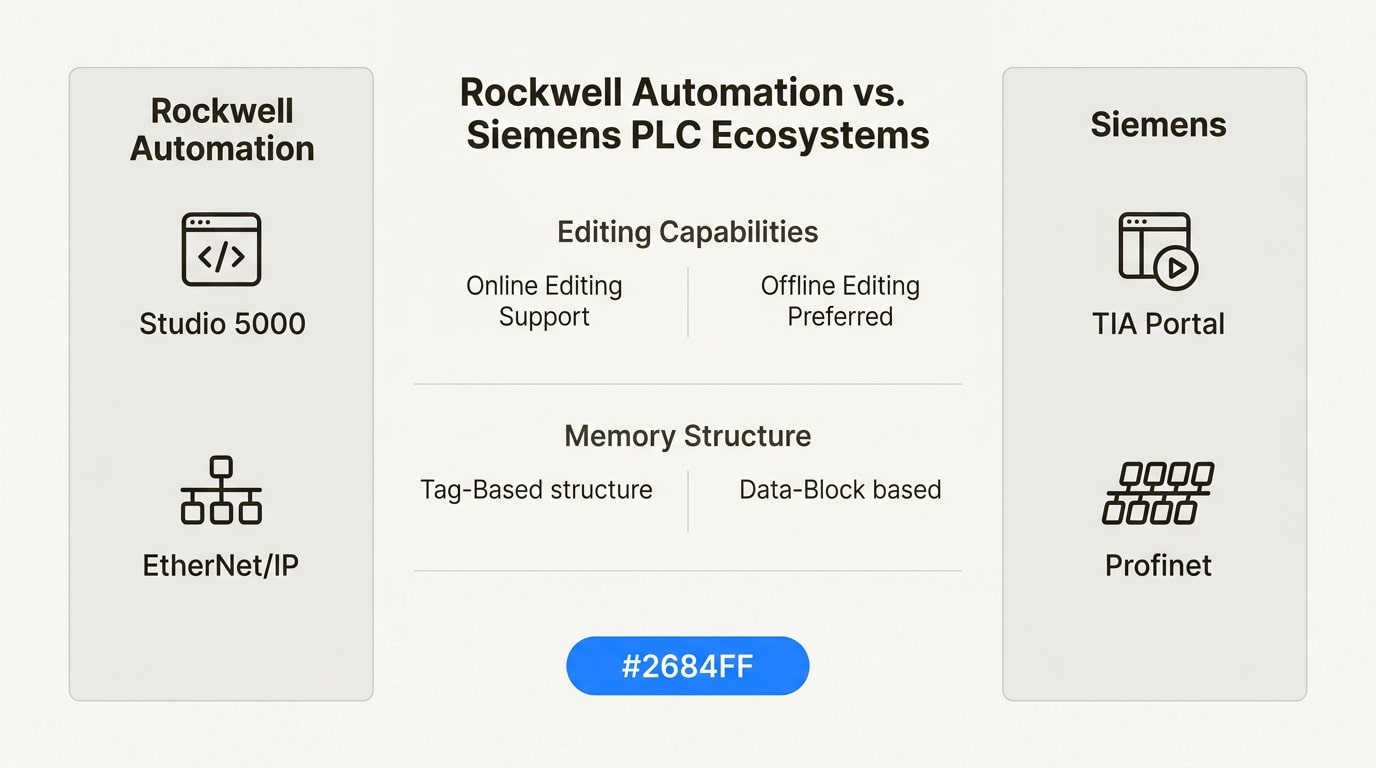
The fundamental difference between these platforms starts with how they handle data and program structure.
Rockwell Studio 5000
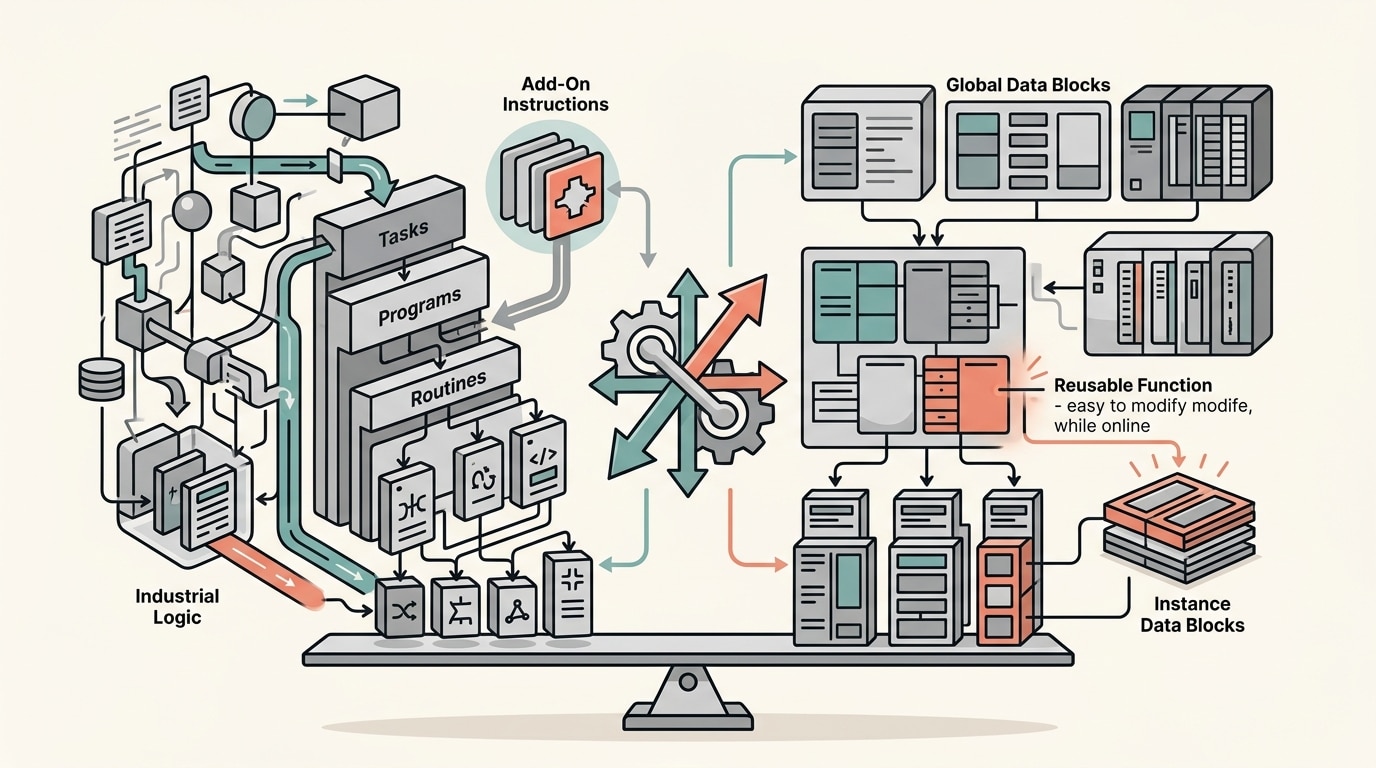
Rockwell uses a tag-based programming model that many Australian engineers find intuitive. In Studio 5000 Logix Designer, you work with controller-scoped tags (global) and program-scoped tags (local). The program structure follows a hierarchy: Tasks contain Programs, which contain Routines where your actual logic lives.
Tasks determine execution timing. You get continuous tasks (run as fast as possible), periodic tasks (run at fixed intervals like every 10ms), and event tasks (triggered by specific conditions). For reusable logic, Rockwell offers Add-On Instructions (AOIs). Think of these as custom function blocks you create once and instantiate multiple times.
The catch with AOIs? Any modification requires a CPU stop to download the changes. In a continuous process plant, that downtime can be costly.
Siemens TIA Portal
Siemens TIA Portal takes a different approach with data blocks. Instead of tags, you work with Global Data Blocks (shared across the program) and Instance Data Blocks (tied to specific function block instances). The program structure uses Organization Blocks (OBs) for execution control, Function Blocks (FBs) for reusable logic with memory, and Functions (FCs) for logic without retained memory.
Here’s where Siemens has an edge for maintenance: Function Blocks can be modified during runtime without stopping the CPU. For plants running 24/7 operations, this is significant. You can fix logic or add functionality without shutting down production.
TIA Portal also integrates more engineering disciplines in one environment. PLC programming, HMI development, drive configuration, and safety programming all happen in the same software suite. For complex projects, this reduces the tool chain complexity.
The learning curve reality
Engineers transitioning between these platforms often struggle initially. As one engineer with 30 years of Rockwell experience noted on PLCtalk: “They keep saying how convenient Data Blocks are, but I can use Rockwell’s controller tags just as easy, and in a more uniformed way.”
The reverse transition has its own challenges. Engineers moving from Siemens to Rockwell often miss the structured data block approach and the ability to modify logic online. Both transitions require dedicated training time. Expect 3 to 6 months before an experienced engineer becomes fully productive on the new platform.
Hardware comparison: ControlLogix vs S7
Both vendors offer scalable hardware families, but their approaches differ.
Rockwell hardware families
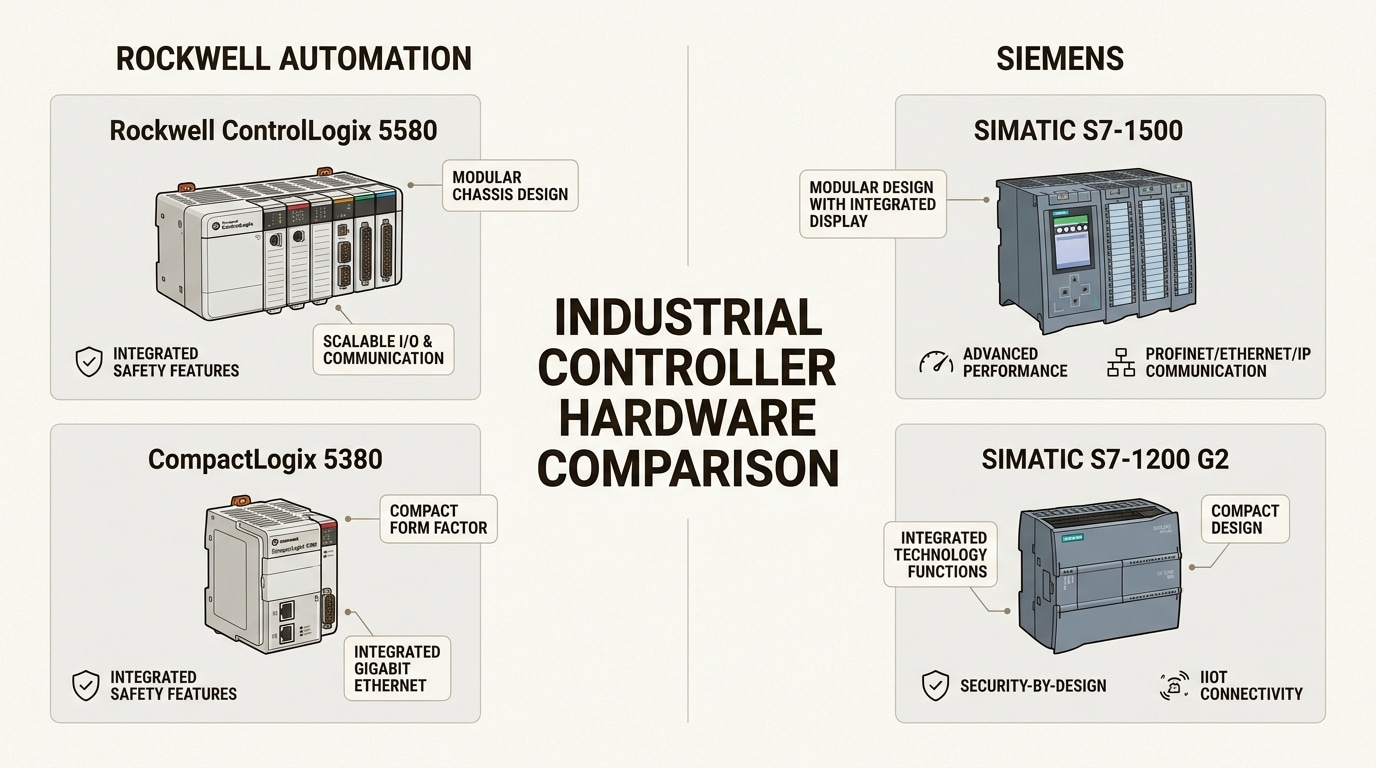
For large applications, Rockwell’s ControlLogix family provides modular, high-performance control. The 5580 and 5590 controllers offer expanded memory, faster scan times, and integrated safety options. ControlLogix handles complex motion control, process applications, and high-availability systems.
The CompactLogix family targets mid-range applications. The 5380 and 5390 controllers deliver high performance in a more integrated package. These work well for standalone machines or smaller process skids where you don’t need full chassis-based modularity.
At the small end, the Micro800 series (Micro870, Micro850, Micro820) handles basic automation. These are cost-effective for simple machine control and replace the older MicroLogix line.
Siemens hardware families
Siemens SIMATIC S7-1500 represents their advanced controller line. These offer integrated technology functions, high-speed I/O, and built-in diagnostics. The S7-1500 R/H CPUs provide redundancy for critical applications where downtime isn’t an option.
For mid-range applications, the S7-1200 G2 delivers enhanced performance with motion control capabilities and scalable safety. The compact form factor suits machine builders and smaller process applications.
Siemens also offers the ET 200SP distributed I/O system. At 50% narrower than comparable systems, it optimizes cabinet space. The ET 200clean variant provides IP69K-rated hygienic design for food and pharmaceutical applications, a key consideration for Australian food and beverage manufacturers.
Performance differences
Scan times tell part of the story. Siemens S7-1500 controllers routinely achieve 1ms cycle times. In Rockwell systems, a 10ms periodic task is considered fast. For high-speed packaging or motion control applications, this difference matters. For typical process control with slower dynamics, either platform handles the workload comfortably.
Memory architecture also differs. Rockwell uses a tag-based memory model where you define the scope explicitly. Siemens uses data blocks that can be optimized for access speed. In practice, both handle substantial applications, but the programming approach affects how you structure your code.
Network protocols and integration
Your existing infrastructure and equipment OEM preferences often dictate protocol requirements.
Rockwell: EtherNet/IP focus
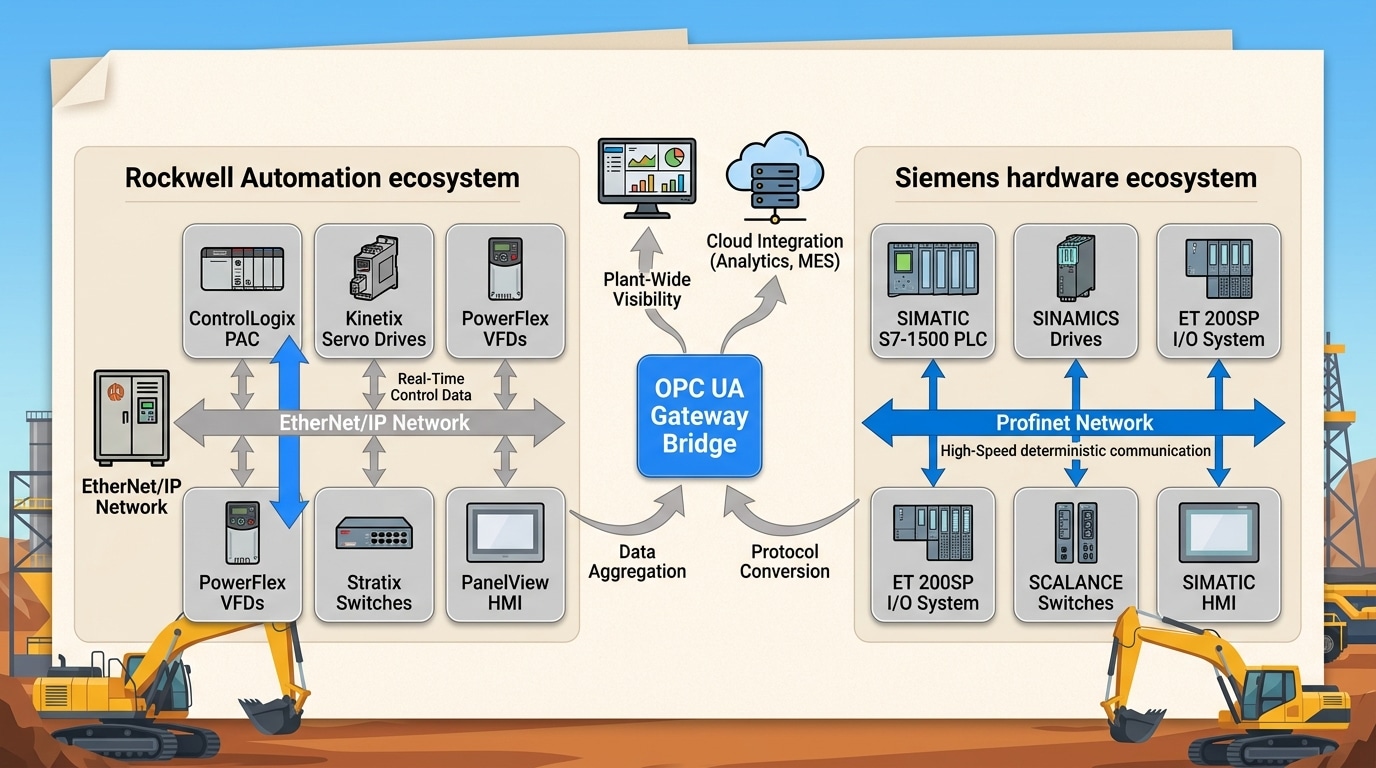
Rockwell champions EtherNet/IP as the primary industrial Ethernet protocol. Their controllers natively support EtherNet/IP for I/O, drives, and peer-to-peer communication. This works seamlessly with Allen-Bradley drives, PanelView HMIs, and third-party devices that support the protocol.
Legacy support includes DeviceNet and ControlNet, though these are gradually being phased out in favor of EtherNet/IP. For motion control, Rockwell’s CIP Motion protocol runs over standard EtherNet/IP hardware, simplifying cabling for servo systems.
Siemens: Profinet leadership
Siemens built its ecosystem around Profinet, the industrial Ethernet extension of Profibus. Profinet offers real-time communication with deterministic performance for I/O and drive control. The protocol supports device replacement without configuration tools, handy for maintenance teams.
Siemens hardware typically supports multiple protocols natively. Their MultiFieldbus capability allows the same I/O hardware to communicate via Profinet, EtherNet/IP, or Modbus/TCP. This flexibility benefits plants with mixed vendor environments or those transitioning between protocols.
Multi-vendor integration
For plants running both platforms, OPC UA provides a common ground. Both Rockwell and Siemens controllers support OPC UA for data exchange with MES systems, historians, and cloud platforms. Gateway devices can translate between EtherNet/IP and Profinet for direct controller-to-controller communication.
In Australian mining operations, we often see hybrid environments. The crushing and grinding circuit might use Siemens for its process control heritage, while the packaging line runs Rockwell for its motion control strengths. Integration between these systems is standard practice now.
Regional strengths and Australian considerations
The best PLC for your application depends partly on where you operate.
Regional market presence
Rockwell dominates the North American market. If you’re running a plant with US-based parent company standards, you’ll likely encounter Rockwell specifications. Their strength in discrete manufacturing, automotive, and packaging is well established.
Siemens leads in Europe and has strong penetration in Asia. For global companies standardizing on one platform worldwide, Siemens often wins due to its broader international support network. Their heritage in process industries, pharmaceuticals, and utilities runs deep.
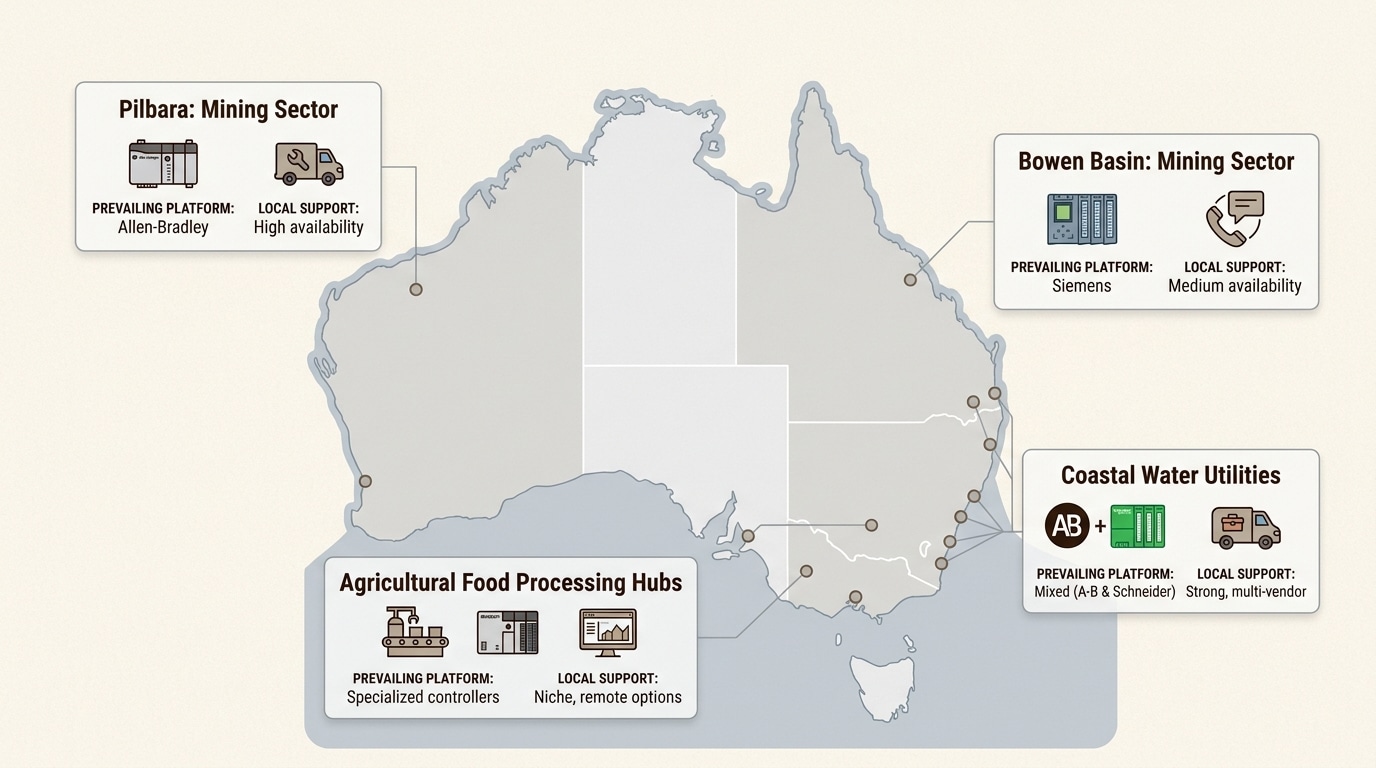
In Australia, the market is split. Mining often follows the equipment OEM’s preference, which varies by supplier. Water utilities have historically leaned toward certain vendors based on regional standards. Food and beverage tends toward Rockwell for packaging lines and Siemens for process areas.
Parts availability and support in Queensland
This is where the theoretical comparison meets practical reality. When a critical controller fails at 2 AM on a Sunday, you need parts now, not in three weeks.
Rockwell has established distribution channels in Australia. Their PartnerNetwork includes local system integrators and distributors. For common ControlLogix and CompactLogix components, stock is generally available in major Australian cities.
Siemens maintains a significant presence in Australia with local technical support. Their SiePortal provides 24/7 access to documentation and support requests. Spare parts availability for S7-1500 and ET 200SP components is generally good through their distribution network.
At Endless Process Automation, we maintain relationships with both supply chains. This means we can source hard-to-find parts for either platform and often expedite delivery for critical breakdowns. For Queensland-based operations, having local support who understands both platforms reduces risk.
Industry-specific considerations
Mining: Heavy mobile equipment often specifies the controller. Fixed plant infrastructure gives you more choice, but integration with OEM equipment may dictate the platform. Heat, dust, and vibration in the Pilbara or Bowen Basin require rugged hardware rated for extreme conditions.
Water and wastewater: Australian water utilities often have standardized platforms based on historical decisions. Migration projects need careful planning to maintain compliance with regulatory requirements.
Food and beverage: Hygienic design requirements favor certain hardware form factors. Siemens ET 200clean and Rockwell’s On-Machine I/O both address these needs, but the specific application determines the better fit.
Oil and gas: Safety instrumented systems (SIS) requirements add complexity. Both vendors offer SIL-rated controllers, but your safety philosophy and existing infrastructure influence the choice.
Total cost of ownership comparison
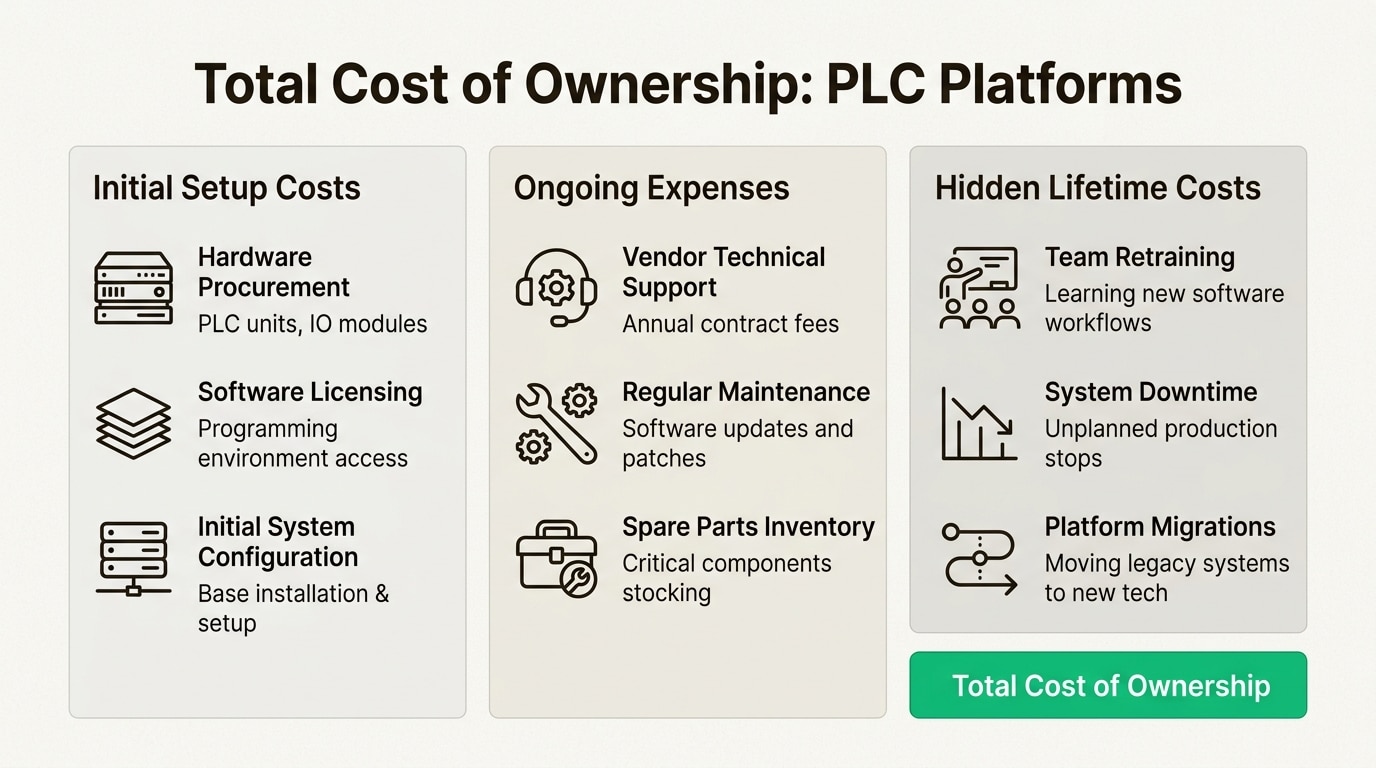
The purchase price is just the beginning. Here’s what affects long-term costs.
Software licensing models
Rockwell traditionally uses perpetual licenses with ongoing support subscriptions. Studio 5000 Professional Edition includes the core programming environment, but additional modules for advanced features cost extra. Annual support agreements provide access to updates and technical support.
Siemens offers a mix of perpetual and subscription licensing. TIA Portal can be purchased outright or accessed through subscription models. The STEP 7 Professional license covers PLC programming, while WinCC covers HMI development. For some advanced features, subscription-based options exist.
Training and certification costs
Both vendors offer comprehensive training programs. Rockwell’s Learning+ Portal and instructor-led courses provide structured learning paths. Siemens SITRAIN offers similar options with digital learning platforms and hands-on courses.
For a maintenance team of five engineers, expect to budget $15,000 to $25,000 for initial training on a new platform. Ongoing training for new features and refresher courses add to this over time.
Spare parts inventory strategy
Maintaining spare parts for critical components is essential. For a typical medium-sized plant, spare parts inventory for either platform might include:
- One spare controller (high-end model in use)
- Two to four spare I/O modules (mixed analog and digital)
- One spare communication module
- Power supplies and accessories
Budget $20,000 to $50,000 for initial spare parts inventory, depending on plant size and criticality. The key is matching your inventory to actual failure rates and lead times for replacement.
Making the right choice for your application
There’s no universal winner. The right choice depends on your specific context.
When Rockwell makes sense
- Your existing infrastructure is Rockwell-based, and migration costs would be prohibitive
- Your team has deep Rockwell experience and certification
- You’re integrating primarily with North American OEM equipment
- Your application emphasizes high-speed discrete control and motion
- You need the simplicity of tag-based programming for rapid development
When Siemens makes sense
- You’re standardizing globally and need consistent platforms across regions
- Your application involves complex process control, batch management, or DCS functionality
- Online editing without CPU stop is critical for your operations
- You’re integrating with European OEM equipment
- You want integrated safety, drives, and HMI in one engineering environment
The vendor-neutral alternative
Here’s the reality: both platforms are capable. Both will run your plant reliably for decades if implemented correctly. The wrong choice isn’t necessarily the platform itself. It’s choosing based on a single vendor’s recommendation without understanding the alternatives.
At Endless Process Automation, we take a different approach. As a vendor-neutral automation partner, we can source and support both Rockwell and Siemens. We assess your actual requirements: existing infrastructure, team skills, OEM equipment, support needs, and budget constraints. Then we recommend the platform that fits best.
We also support hybrid environments. Many plants run Rockwell in one area and Siemens in another. We can integrate these systems, provide cross-platform support, and help with migration planning when it makes sense.
Get expert advice on your PLC platform decision
The PLC platform decision affects your operations for years. Get advice from engineers who understand both systems and can recommend based on your actual needs, not a sales quota.
At Endless Process Automation, we have over 20 years of field experience across mining, water, energy, and manufacturing in Queensland and regional Australia. We understand the local conditions: heat, dust, humidity in Gladstone, and the remote locations where support isn’t just a phone call away.
We can source both Rockwell and Siemens hardware with competitive pricing, provide local support, and help you build a spare parts strategy that makes sense for your operation. If you’re considering a new project, expansion, or platform migration, contact us for a technical assessment.
Frequently Asked Questions
Which is easier to learn for engineers new to PLCs, Rockwell or Siemens?
Rockwell’s tag-based programming is often considered more intuitive initially. The concept of tags maps directly to physical I/O and internal variables in a way that feels natural. Siemens TIA Portal has a steeper learning curve but offers more powerful features for complex applications. Most engineers can become productive on Rockwell faster, but Siemens rewards the investment with more flexible programming capabilities.
Can Rockwell and Siemens PLCs communicate directly with each other?
Yes, through several methods. OPC UA provides a standard way to exchange data between controllers for integration with SCADA and MES systems. For direct controller-to-controller communication, protocol gateways can translate between EtherNet/IP and Profinet. In practice, many plants run both platforms and integrate them successfully.
Which platform has better long-term support for legacy systems?
Both vendors provide extended support for legacy products, but Siemens generally offers longer official hardware support cycles. Rockwell has an extensive network of third-party support channels, particularly in North America. For Australian operations, both provide adequate support, but parts availability for very old systems depends on the specific components.
Is one platform better for safety instrumented systems (SIS)?
Both Rockwell (GuardLogix) and Siemens (SIMATIC Safety) offer TÜV-certified safety controllers rated up to SIL 3. The choice usually depends on the safety network protocol and the base control system. If your standard control is Rockwell, GuardLogix integrates seamlessly. The same applies to Siemens with SIMATIC Safety.
How do software licensing costs compare between Rockwell and Siemens?
Both use similar licensing models with perpetual licenses and support subscriptions. Exact pricing varies by product tier and features. Rockwell traditionally charges for individual software modules, while Siemens bundles more features in base packages. For accurate pricing specific to your application, contact a distributor or Endless Process Automation for a quote.
Which platform is more common in Australian mining operations?
It varies by application and equipment OEM. Fixed plant infrastructure often uses Siemens for its process control strengths. Mobile equipment and packaging lines often use Rockwell. Many mines run hybrid environments with both platforms. The key is matching the platform to the application and your team’s expertise.
Can Endless Process Automation support both Rockwell and Siemens systems?
Yes. As a vendor-neutral automation partner, we source, install, and support both platforms. We can help with new projects, upgrades, spare parts sourcing, and emergency support for either system. Our engineers have hands-on experience with both Rockwell and Siemens in Australian industrial conditions.