
Your PLC fails at 2 AM on a Sunday in the Pilbara or Bowen Basin. The control room phone rings. Who’s answering? More importantly, who can actually fix it?
In Australian mining, a failed controller doesn’t just mean downtime. It means lost production worth millions per hour, safety systems going offline, and the very real possibility that your spare parts are sitting in a warehouse three time zones away. The choice between Rockwell Automation, Siemens, and Schneider Electric isn’t about brand loyalty. It’s about which platform won’t leave you stranded when the dust is flying and the temperature’s pushing 50°C.
Why your PLC choice matters in Australian mining conditions
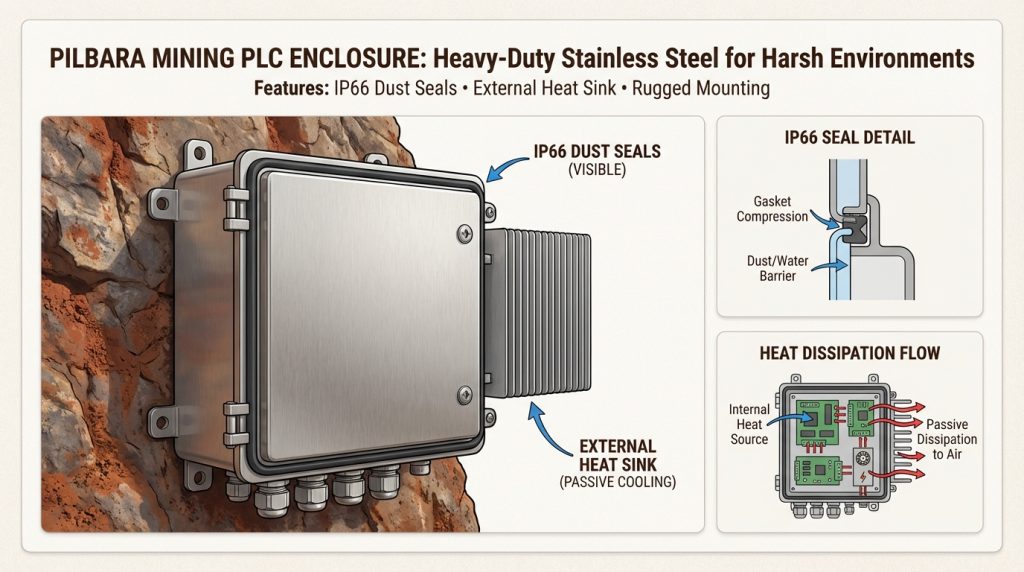
Queensland’s Bowen Basin and Western Australia’s Pilbara region present some of the harshest operating environments on Earth for industrial electronics. We’re talking about ambient temperatures regularly exceeding 50°C in summer, dust ingress that can destroy unprotected equipment in weeks, and humidity levels in coastal processing plants that corrode circuit boards.
A coal processing plant losing $50,000 per hour of downtime needs reliable local support more than a 10% hardware discount. This is where regional support availability becomes a deciding factor. When something fails at a remote site, you need to know who can respond and how quickly.
The three dominant players each bring distinct strengths to Australian industrial applications. At Endless Process Automation, we source and support all three brands, so this comparison comes from hands-on experience across mining, water, and manufacturing sites throughout Queensland.
Rockwell Automation (Allen-Bradley): The Australian mining standard
Rockwell Automation remains the key industry standard for many Australian mining operations. Their Allen-Bradley PLCs have the strongest local support network in Australia, particularly in Queensland’s mining regions.
Key product lines
The ControlLogix series offers high-performance control with integrated safety, high-speed processing, and built-in security. These PLCs handle process and batch control, discrete and motion control, and hybrid automation systems. The CompactLogix series provides a scalable solution for mid-size applications requiring high data throughput and faster system performance. For smaller applications, the MicroLogix series delivers cost-effective control with enhanced network capabilities.
Where Rockwell fits Australian mining
Rockwell’s dominance in Australian mining comes down to three factors: ecosystem maturity, local support density, and motion control capabilities. The GuardLogix safety controllers offer embedded advanced safety functions compliant with SIL 3 standards, essential for mining equipment that must stop instantly upon detecting hazards.
The Studio 5000 programming environment uses tag-based programming that Australian engineers find intuitive. Online editing capabilities allow program changes without stopping production, a critical feature when you’re running continuous processing operations.
The catch? You’ll pay a premium for it. Allen-Bradley hardware typically costs 20-35% more than equivalent Siemens components. The 2021-2023 chip shortage hit Allen-Bradley particularly hard, with some CompactLogix processors on 6-month backorder.
Siemens SIMATIC: The process control specialist
Siemens holds 30-35% of the global PLC market for good reason. Their SIMATIC controllers are engineered for complex, data-intensive applications, and they consistently deliver lower hardware costs than Allen-Bradley.
Key product lines
The S7-1500 series represents Siemens’ flagship platform, ideal for automating applications with extremely high demands for availability, flexibility, and performance. The S7-1200 series handles entry-level to mid-range applications with integrated I/O and communication ports. The ET 200SP distributed I/O system offers high system availability for special-purpose applications.
Where Siemens fits Australian industry
Water treatment facilities across Queensland increasingly specify Siemens. The analog control capabilities are superior for flow, pressure, and level control loops. For mining process control, from slurry handling to tailings management, Siemens offers hazardous area certifications and proven reliability in harsh environments.
The TIA Portal engineering environment includes built-in simulation (PLCSIM Advanced) that can reduce commissioning time by 30-50%. This matters when you’re under pressure to get a new processing line online before the wet season hits.
The trade-off is local support. While Siemens is investing heavily in Australian presence, you’ll find fewer Siemens specialists in regional areas compared to Rockwell-trained technicians. For remote sites, consider who can respond when something fails at 2 AM on a Sunday.
Schneider Electric Modicon: The energy and infrastructure choice
Schneider Electric often gets overlooked in PLC comparisons, but their Modicon range deserves serious consideration for specific applications. The EcoStruxure platform integrates energy management, IoT connectivity, and open protocol support in ways the other two don’t match.
Key product lines
The Modicon M580 is Schneider’s advanced offering and the world’s first ePAC (Ethernet Programmable Automation Controller) with native Ethernet built into the backplane. The M251 and M241 series handle machine automation with dual-channel communications and position control functions. The M221 nano-PLC series covers basic automation needs.
Where Schneider fits Australian industry
If you’re working on water industry, renewable energy, or infrastructure projects, Schneider’s open architecture is compelling. The Modicon range supports multiple protocols natively, including Modbus TCP, EtherNet/IP, and OPC UA, without expensive gateway modules.
Energy management is where Schneider truly differentiates. Their PLCs integrate seamlessly with power meters, variable speed drives, and energy monitoring systems. For facilities chasing NABERS ratings or carbon targets, this integration can justify the platform choice alone.
The trade-off is market presence. You’ll find fewer Schneider specialists in Australia compared to Allen-Bradley or Siemens, and the ecosystem of third-party integration partners is smaller.
Technical comparison: Specs, software, and integration
Choosing a PLC platform locks you into an ecosystem. Here’s what that means in practice for Australian mining applications.
Hardware specifications
| Specification | Rockwell ControlLogix | Siemens S7-1500 | Schneider M580 |
|---|---|---|---|
| CPU Performance | Up to 0.1ms per 1000 instructions | Up to 0.04ms per 1000 instructions | Varies by model |
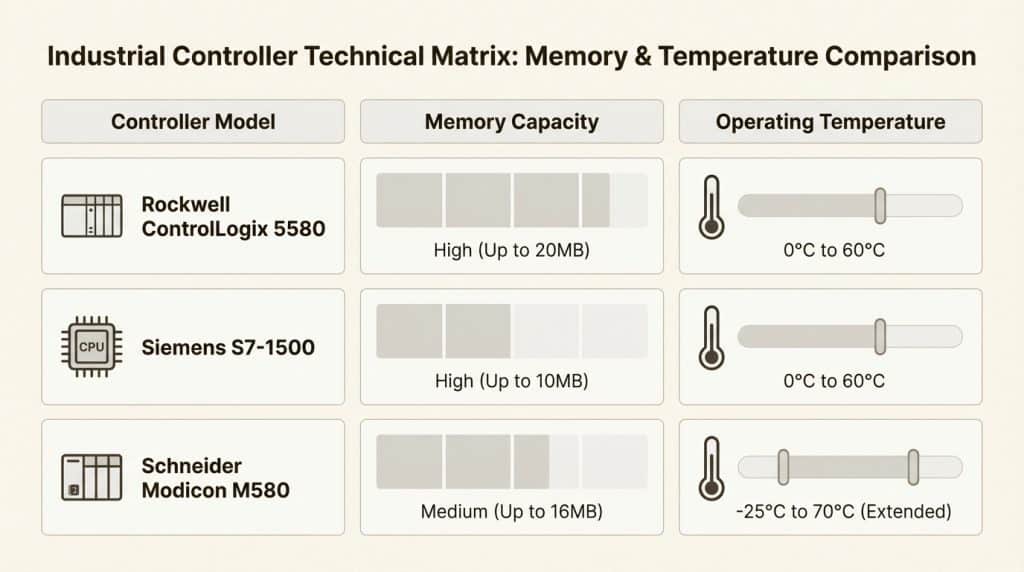
| Memory | 2MB to 20MB user memory | Up to 32MB work memory | Up to 32MB |
| Operating Temp | 0°C to 60°C (varies by model) | -25°C to 60°C | -25°C to 70°C |
| Safety Rating | SIL 3 (GuardLogix) | Integrated safety functions | Achilles Level 2 |
| I/O Capacity | Up to 128,000 digital I/O | Up to 32,000 digital I/O | Up to 2,048 I/O |
Programming environments
Studio 5000 (Rockwell) uses tag-based programming that North American engineers find intuitive. Cost ranges from $8,000 to $20,000 depending on safety and motion features.
TIA Portal (Siemens) offers a steeper initial learning curve but genuinely integrated engineering. PLC code, HMI screens, safety logic, and drive configuration live in one project file. Cost ranges from $1,800 to $15,000.
EcoStruxure Machine Expert (Schneider) is free for Modicon programming. It lacks some polish of the big two but handles basic to mid-range applications competently.
Communication protocols
| Brand | Primary Protocol | Legacy Support | Open Protocols |
|---|---|---|---|
| Rockwell | EtherNet/IP | ControlNet, DeviceNet | Modbus TCP, OPC UA via modules |
| Siemens | Profinet/Profibus | MPI, AS-Interface | EtherNet/IP, Modbus TCP, OPC UA native |
| Schneider | Modbus TCP/Ethernet | Modbus RTU, CANopen | Multiple native, including OPC UA |
If you’re integrating with existing equipment, protocol compatibility matters more than brand preference. A facility running legacy DeviceNet will find Allen-Bradley integration straightforward. Sites with European equipment will likely encounter Profinet. Schneider’s multi-protocol support can simplify mixed environments.
Total cost of ownership: Beyond the hardware price
Hardware prices tell only part of the story. Here’s a realistic comparison for a typical small-to-medium system with 100 I/O points:
| Component | Rockwell Allen-Bradley | Siemens | Schneider |
|---|---|---|---|
| Controller (mid-range) | $2,500-4,500 | $1,800-3,500 | $1,500-3,000 |
| Digital I/O modules (16-point) | $120-300 | $80-250 | $90-220 |
| Analog I/O modules | $250-700 | $200-600 | $180-550 |
| Programming software | $8,000-20,000 | $1,800-15,000 | Free-$5,000 |
| Typical system total | $12,000-25,000 | $8,000-18,000 | $7,000-15,000 |
Hidden costs that matter
Engineering time often exceeds hardware costs. A programmer familiar with Allen-Bradley will complete a project 30-50% faster than learning Siemens from scratch. Factor training time into your total cost calculation.
Spare parts inventory becomes significant for critical applications. Single-vendor standardization reduces spare parts variety but increases vulnerability to supply chain disruptions.
Downtime costs dwarf hardware savings. This is where regional support availability becomes a deciding factor. Rockwell maintains the strongest local support network in Australia, particularly in Queensland’s mining regions. Siemens is investing heavily in local presence but still lags in regional coverage. Schneider has good energy and utility sector support but weaker manufacturing presence.

Which PLC should you choose for your mining application?
There’s no universally “best” PLC. The right choice depends on your specific application, existing infrastructure, and operational priorities.
Choose Rockwell Automation if:
- You’re running discrete manufacturing, packaging, or material handling
- Motion control and servo integration are critical
- You have existing Rockwell infrastructure and trained staff
- North American compliance or customer specifications require it
- Budget allows for premium pricing in exchange for ecosystem maturity and strongest local support
Choose Siemens if:
- Process control is your primary application (water, chemical, slurry handling)
- You’re cost-sensitive but need enterprise-grade capabilities
- European standards compliance or global standardization matters
- You need advanced simulation and digital twin capabilities
- Your team has TIA Portal experience or is willing to invest in training
Choose Schneider Electric if:
- Energy management and efficiency are priorities
- You’re building IoT-connected infrastructure
- Multi-protocol flexibility is essential
- You want to avoid vendor lock-in through open architecture
- You’re working in building automation, renewables, or utilities
The vendor-neutral advantage
Here’s the reality most distributors won’t tell you: no single brand is optimal for every application. The smartest approach is matching the platform to the specific requirements of each system.
We’ve seen facilities successfully mix platforms. A mining site might use Siemens for process control, Allen-Bradley for packaging lines, and Schneider for energy management. Protocol gateways and unified SCADA systems make this integration manageable.
The key is avoiding religious attachment to any brand. Each has strengths and weaknesses. Your job is matching those to your operational requirements.
Get vendor-neutral PLC advice for your Australian mining project
As an independent technical sourcing partner, we approach PLC selection differently than brand-authorized distributors. We’re not incentivized to push any particular manufacturer. Our recommendations are based on what actually works for your application.
We start with site assessment. What are you controlling? What’s your existing infrastructure? Who maintains the equipment? These questions matter more than brand specifications.
For greenfield projects, we evaluate multiple options against your specific requirements. For brownfield expansions, we assess integration complexity and legacy compatibility. Sometimes the “best” technical solution isn’t worth the migration cost. We’ll tell you honestly when that’s the case.
Our relationships with Rockwell Automation, Siemens, and Schneider Electric give us competitive pricing across all three platforms. When supply chain disruptions hit, we can often source alternatives that brand-locked distributors can’t offer.
We’ve spent 20+ years in Queensland’s heavy industries. We understand what 50°C+ heat does to electronics. We know the dust ingress challenges in Pilbara iron ore operations. We’ve dealt with the humidity issues in Gladstone process plants.
This matters because specification sheets don’t tell the full story. A controller rated for 60°C ambient might struggle in a Queensland summer without proper enclosure design. We specify for real Australian conditions, not laboratory environments.
Need technical advice or a hard-to-find part? Contact Endless Process Automation for a vendor-neutral quote today. We’ll help you select the right platform for your application, then source it at competitive pricing with the integration support to make it work.
Frequently Asked Questions
Rockwell vs. Siemens vs. Schneider: Which PLC is best for the Australian mining environment in 2026 for harsh conditions?
All three brands offer industrial-grade reliability when properly specified. For harsh mining environments, Rockwell and Siemens have longer track records in Australian coal and iron ore operations. Schneider’s M580 series is gaining traction in mining applications requiring IoT connectivity. The key is proper enclosure design and environmental protection, regardless of brand choice.
Rockwell vs. Siemens vs. Schneider: Which PLC is best for the Australian mining environment in 2026 for motion control?
Rockwell Automation leads in motion control and servo integration. Their ControlLogix series integrates motion control capabilities within the PLC module, eliminating the need for separate drives. For applications requiring tight timing and synchronization, such as conveyor systems and robotic material handling, Rockwell is the preferred choice.
Rockwell vs. Siemens vs. Schneider: Which PLC is best for the Australian mining environment in 2026 for cost-sensitive projects?
Siemens typically offers the best value for cost-sensitive projects. Hardware costs are 20-35% lower than Allen-Bradley, and TIA Portal software licensing is less expensive than Studio 5000. However, factor in engineering time and support availability. If your team knows Allen-Bradley, the productivity advantage may offset hardware savings.
Rockwell vs. Siemens vs. Schneider: Which PLC is best for the Australian mining environment in 2026 for remote sites?
Rockwell Automation has the strongest local support network in Australian mining regions, particularly Queensland. For remote sites where technician availability is critical, this support infrastructure can outweigh hardware cost considerations. Siemens is expanding its Australian presence but has fewer regional specialists.
Rockwell vs. Siemens vs. Schneider: Which PLC is best for the Australian mining environment in 2026 for integration with existing systems?
Schneider Electric offers the most flexible integration options with native support for multiple protocols (Modbus TCP, EtherNet/IP, OPC UA) without expensive gateway modules. If your facility has mixed legacy systems from multiple vendors, Schneider’s open architecture can simplify integration challenges.
Rockwell vs. Siemens vs. Schneider: Which PLC is best for the Australian mining environment in 2026 for process control applications?
Siemens dominates process control applications globally due to superior analog control capabilities and the integrated TIA Portal environment. For water treatment, chemical processing, and slurry handling common in mining operations, Siemens S7-1500 series offers the best combination of performance and value.
What are the current lead times for PLC hardware in Australia?
Lead times vary by brand and component. Allen-Bradley CompactLogix processors have faced extended delays (3-6 months) due to ongoing supply chain constraints. Siemens S7-1500 availability has improved but specific modules may still face delays. Schneider generally has shorter lead times due to smaller market share. Working with a multi-vendor supplier provides access to alternatives when primary choices are unavailable.