

Every engineer faces the same question when specifying a new control system: which platform do you standardise on? For many Australian industrial operations, the choice comes down to two dominant players: Schneider Electric and Rockwell Automation (Allen-Bradley).
Both manufacturers have fundamentally different approaches to industrial automation. Rockwell dominates North American manufacturing with premium-priced, tightly integrated systems. Schneider brings a more open, protocol-flexible philosophy with competitive pricing and strong energy management credentials.
In Queensland’s industrial landscape, local support availability, software licensing costs, and hardware durability in harsh conditions matter more than brand prestige. As an independent technical sourcing partner, we help engineers navigate this decision based on application requirements, not sales quotas. Let’s break down what actually matters when choosing between these platforms.
Understanding the two platforms
What is Rockwell Automation (Allen-Bradley)?
Rockwell Automation is a US-based industrial automation giant headquartered in Milwaukee, Wisconsin. Founded in 1903, the company has built its reputation on the Allen-Bradley brand, which has become synonymous with industrial control in North America.
Rockwell’s product portfolio spans the full range of controller sizes. The Micro800 series handles entry-level applications, while CompactLogix 5380/5390 controllers target mid-range smart machines. For high-performance applications, the ControlLogix 5580/5590 PACs deliver advanced processing, security features, and expanded memory.
The company’s native protocol is EtherNet/IP, which has become the de facto standard in many North American facilities. Rockwell also maintains legacy support for DeviceNet and ControlNet, though these are gradually being phased out in favor of Ethernet-based solutions.
Rockwell commands premium pricing across its product range, but this comes with extensive training infrastructure, a massive installed base, and deep integration between hardware and software. For operations with existing Rockwell infrastructure, staying within the ecosystem often makes technical sense even if the initial purchase price gives procurement pause.
What is Schneider Electric?
Schneider Electric is a French multinational founded in 1836, making it one of the oldest companies in the automation space. While Rockwell built its reputation in discrete manufacturing, Schneider has deep roots in energy management and infrastructure automation.
Schneider’s Modicon brand (the name comes from “MOdular DIgital CONtroller”) offers a tiered product line. The M221 handles simple machine applications with easy configuration. The M241/M251 series adds motion control capabilities and enhanced Ethernet connectivity. For demanding applications, the M580 ePAC (Ethernet Programmable Automation Controller) brings native Ethernet, built-in cybersecurity, and high-performance processing.
Schneider’s native protocol is Modbus TCP/RTU, though their controllers support multiple protocols including EtherNet/IP, Profinet, and Profibus. The company has been particularly aggressive about building IoT integration through its EcoStruxure platform, which connects edge devices to cloud analytics.
Pricing sits noticeably below Rockwell equivalents. Entry-level controllers start around $400 compared to Rockwell’s $1,000+ entry point. Mid-range systems typically run $800-$2,000 versus Rockwell’s $2,000-$5,000 range. For budget-conscious projects or operations looking to standardize on a single vendor across multiple sites, Schneider’s pricing can be compelling.
Programming software comparison
Rockwell: Studio 5000 Logix Designer
Rockwell’s Studio 5000 Logix Designer serves as the unified development environment for the entire Logix 5000 family. It handles PLC programming, HMI configuration, motion control setup, and network management from a single interface.
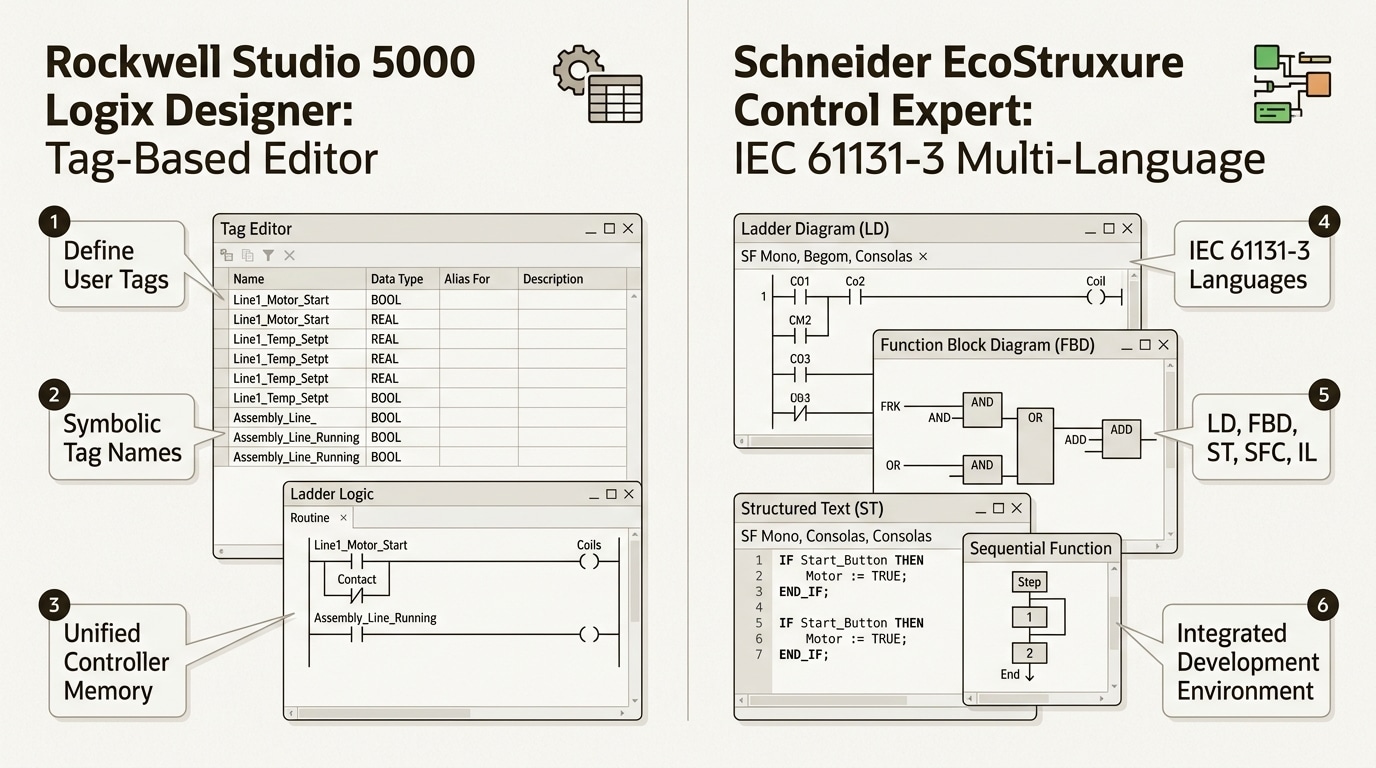
The software uses a tag-based programming paradigm rather than traditional memory addressing. This approach feels more intuitive to programmers coming from modern software development backgrounds, though it can confuse engineers trained on older PLC systems. The unified environment means you do not switch applications when moving between controller types, which streamlines development for operations running mixed Rockwell hardware.
On the downside, Rockwell’s instruction set is proprietary. Engineers familiar with IEC 61131-3 standards will need to learn Rockwell-specific terminology and function blocks. The learning curve is steeper for teams without existing Rockwell experience.
Software licensing represents a significant ongoing cost. Studio 5000 requires paid licenses, and Rockwell has moved toward subscription models with annual support fees. Version compatibility can also create challenges. Opening a program created in a newer version in an older software release often fails, forcing entire teams to upgrade simultaneously.
Schneider: EcoStruxure Control Expert and Machine Expert
Schneider takes a different approach with EcoStruxure Control Expert (formerly Unity Pro) for the Modicon M340 and M580 series, and EcoStruxure Machine Expert (formerly SoMachine) for the M221, M241, and M251 controllers.
Control Expert provides full IEC 61131-3 compliance, supporting all five standard languages: Ladder Diagram, Function Block Diagram, Structured Text, Instruction List, and Sequential Function Chart. This matters for teams with mixed backgrounds or operations that want to follow international standards rather than vendor-specific conventions.
One standout feature is online editing of user-defined function blocks. You can modify code while the PLC runs without stopping the process, which is invaluable for continuous operations where downtime costs thousands each minute. Schneider’s Ethernet devices also include built-in web servers as standard, allowing diagnostic access through any browser without additional software.
Software licensing costs are generally lower than Rockwell equivalents. While professional versions aren’t free, the pricing structure is less punitive for small teams. Schneider also maintains a single programming package across PLCs, drives, and communications modules, reducing the software sprawl that can complicate Rockwell environments.
Hardware comparison
Entry-level controllers
At the entry level, Rockwell’s Micro800 series (Micro810 through Micro870) competes with Schneider’s M221. Both handle basic logic, discrete I/O, and simple communications.
Rockwell’s Micro800 controllers use Connected Components Workbench for programming, which is simpler than Studio 5000 but also more limited. The hardware is reliable but the product line has seen significant churn, with the Micro830 discontinued as of December 2023. Migration paths exist to other Micro800 models, but this creates uncertainty for long-term projects.
Schneider’s M221 uses EcoStruxure Machine Expert Basic for programming, which is genuinely easy to learn. The hardware includes built-in Ethernet on most models and supports Modbus TCP natively. For simple machines, conveyors, or standalone equipment, the M221 often delivers equivalent capability at roughly half the Rockwell price.
Mid-range systems
The mid-range is where most Australian industrial applications live. Rockwell’s CompactLogix 5380/5390 controllers offer integrated motion control, extensive I/O capacity, and the full power of the Studio 5000 environment. The 5480 variant even includes a Windows 10 IoT Enterprise computer running parallel to the control engine, enabling edge computing applications without separate hardware.
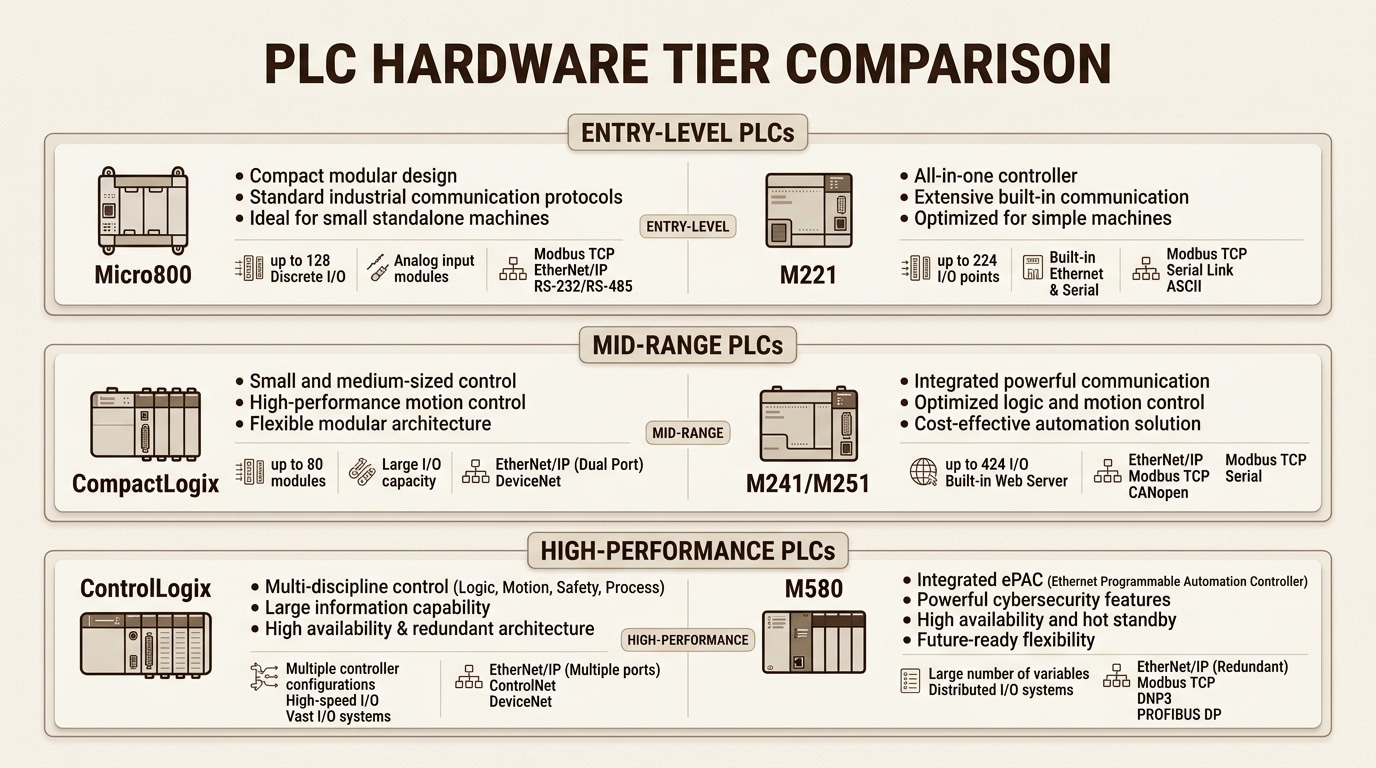
Schneider’s M241 and M251 controllers match this capability with built-in motion control, CANopen master functionality, and extensive communication options. The M251 adds dual Ethernet ports for easy ring topology configuration, a feature that requires additional modules in many Rockwell systems.
For motion control specifically, both platforms handle servo drives and coordinated motion, though Rockwell’s integration with Kinetix servo systems is tighter if you’re already in the Rockwell ecosystem.
High-performance controllers
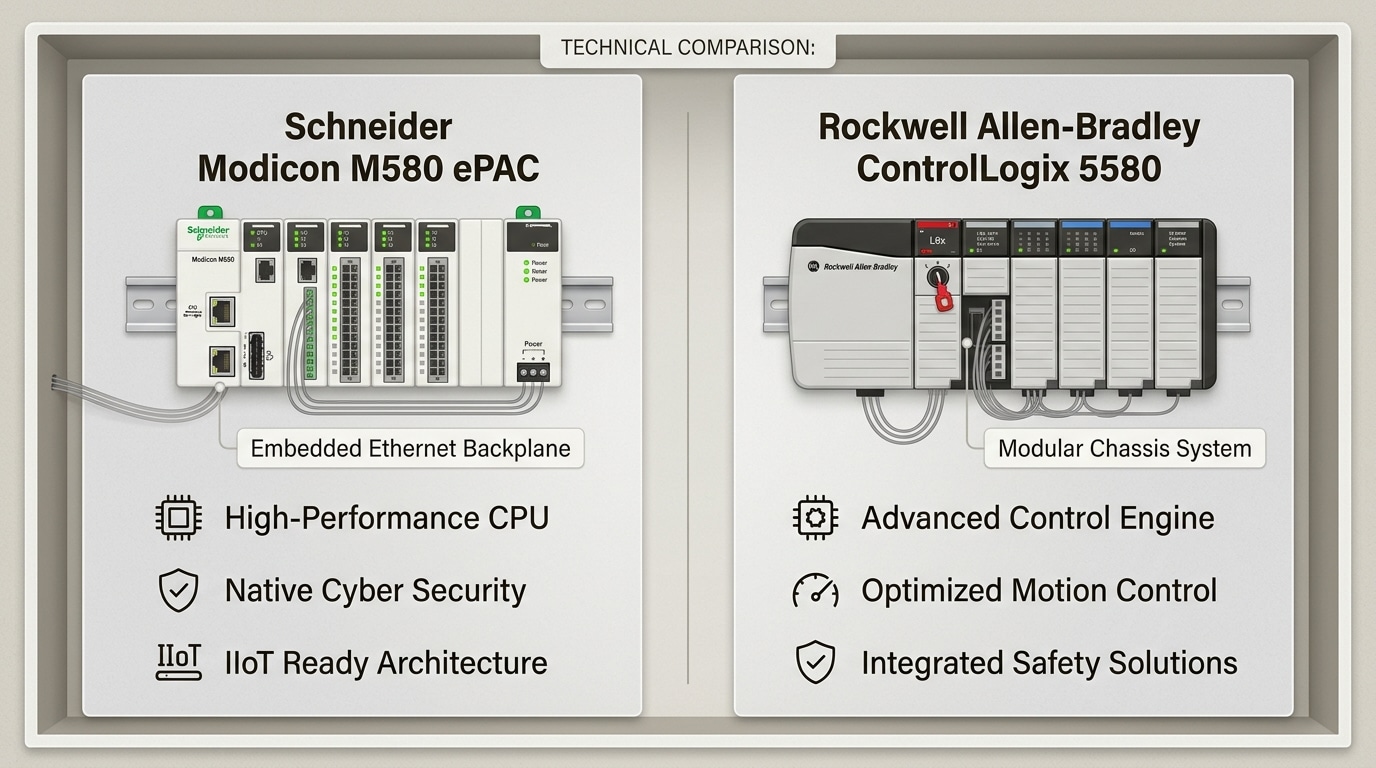
At the high end, Rockwell’s ControlLogix 5580/5590 controllers deliver massive I/O capacity, redundancy options, and safety integration through GuardLogix variants. These controllers handle process control, high-speed manufacturing, and safety-critical applications with SIL2 and SIL3 certifications available.
Schneider’s M580 ePAC competes aggressively in this space with native Ethernet on the backplane, built-in cybersecurity features, and high-performance processing. The ePAC designation reflects Schneider’s focus on Ethernet as the primary communication medium, eliminating the need for separate network modules in many configurations.
Both platforms support redundant controller configurations for high-availability applications. Rockwell has the edge in safety-certified systems, particularly for process industries with strict SIL requirements. Schneider counters with stronger built-in cybersecurity and easier integration with third-party systems through open protocols.
Australian conditions considerations
Queensland’s industrial environments present unique challenges. In the Bowen Basin and Pilbara, summer temperatures regularly exceed 45°C, with equipment enclosures reaching 60°C or higher. Both Rockwell and Schneider specify operating temperature ranges, but real-world performance depends on enclosure design and cooling.
Coastal applications around Gladstone and Mackay face high humidity and salt spray. IP ratings matter here, and both manufacturers offer protected variants, though Schneider’s heritage in water and wastewater applications shows in their environmental sealing designs.
Dust ingress protection is critical for mining operations. Both platforms offer conformal coating options and sealed enclosures, though the specific part numbers and availability in Australia vary. Lead times for specialised variants can stretch to months, so planning ahead matters.
Total cost of ownership analysis
Hardware costs
The upfront hardware cost difference is significant. Entry-level Rockwell controllers typically start around $1,000, while Schneider equivalents run $400-$600. Mid-range systems show similar gaps, with Rockwell CompactLogix controllers often priced at $2,000-$5,000 versus Schneider’s $800-$2,000 range.
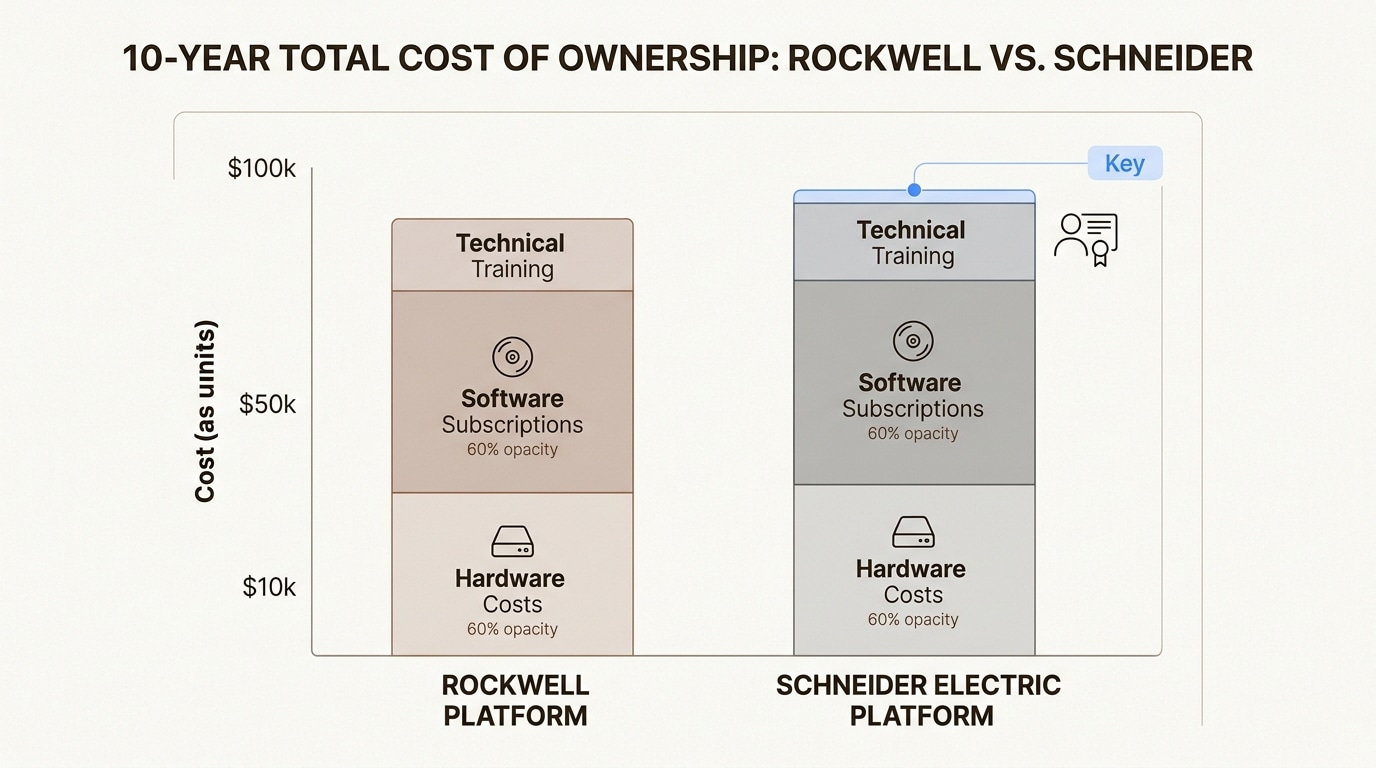
These differences compound across large projects. A control system with twenty PLCs might show a $20,000-$40,000 hardware cost difference between vendors. For capital-constrained projects or operations with tight budgets, this alone can drive the decision.
Software and licensing
Software costs often surprise first-time PLC buyers. Rockwell’s Studio 5000 licenses run into thousands of dollars per seat, with annual support contracts adding ongoing costs. FactoryTalk View for HMI development, RSNetWorx for network configuration, and various other tools each carry separate licensing.
Schneider’s EcoStruxure Control Expert and Machine Expert licenses are generally less expensive, and the company has been less aggressive about pushing subscription models. However, professional-grade functionality still requires paid licenses for both platforms.
Hidden costs include firmware upgrades (sometimes charged), tech support subscriptions, and training. Rockwell’s training infrastructure is more extensive in Australia, but this comes at a premium. Schneider offers online training through Schneider Electric University, which can reduce travel costs for distributed teams.
Support and training
Local support availability matters when a production line is down at 2 AM. Rockwell has an established Australian presence with local sales offices and a PartnerNetwork of integrators. Schneider’s Australian operation includes phone support at 13 73 28 and an EcoXpert partner program for local integration support.
Spare parts availability varies by location. Rockwell’s larger installed base in Australia means more local distributors carry common parts. Schneider’s network is growing but may require longer lead times for some components, particularly specialised modules.
Engineer training represents another cost. Rockwell’s training courses are comprehensive and widely available, but expensive. Schneider’s training is more affordable and increasingly available online, though hands-on courses may require travel to major cities.
When to choose which platform
Choose Rockwell when:
- You have existing Rockwell infrastructure. The cost of migrating programming expertise, spare parts inventory, and operational knowledge often outweighs hardware savings from switching vendors.
- You need complex motion control. Rockwell’s integration with Kinetix servo systems and coordinated motion capabilities are industry-leading for high-precision applications.
- You’re in automotive or heavy industrial manufacturing. Rockwell dominates these sectors for good reason. The ecosystem, third-party support, and proven reliability matter.
- Your parent company standardised on Rockwell. Global corporations often mandate specific platforms. Fighting corporate standards rarely ends well for site engineers.
- Budget allows for premium pricing. If the project has budget flexibility and the additional cost does not compromise other requirements, Rockwell’s ecosystem advantages can justify the premium.
Choose Schneider when:
- Energy management is a priority. Schneider’s heritage in power distribution and energy management shows in their integrated power monitoring and sustainability features.
- You’re in water, wastewater, or infrastructure. Schneider has deep experience in these sectors, with application-specific solutions and proven reliability in harsh environments.
- Budget constraints. The hardware cost savings are significant. For projects where every dollar counts, Schneider delivers equivalent capability at lower cost.
- You need open protocols and IoT integration. Schneider’s native support for multiple protocols and aggressive IoT development through EcoStruxure makes heterogeneous system integration easier.
- Your team prefers IEC 61131-3 standards. If you want portable programming skills and standardised approaches, Schneider’s adherence to international standards is appealing.
The vendor-neutral alternative
Here’s the reality: neither platform is universally superior. The right choice depends on your specific application, existing infrastructure, and operational priorities.
At Endless Process Automation, we source both Rockwell and Schneider, plus alternatives like Siemens and Omron. This independence lets us recommend the best fit for your application rather than pushing whatever brand we have in stock.
For a deeper technical dive on Schneider’s Modicon range, see our Schneider Electric Modicon PLCs technical overview.
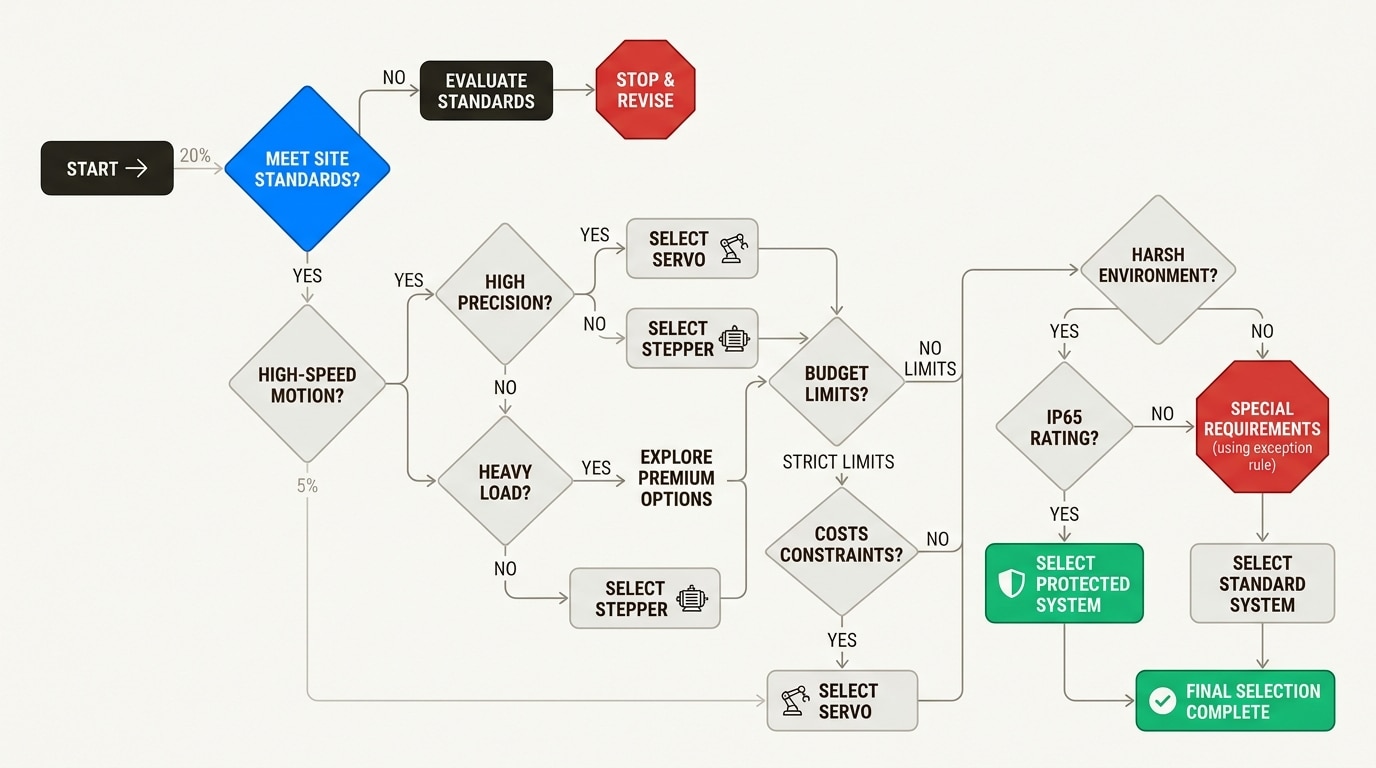
For existing installations, we can develop migration strategies that phase in new hardware without disrupting operations. Hybrid solutions are increasingly common, using protocol gateways to bridge Rockwell and Schneider systems where it makes sense.
Making the right choice for your Queensland operation
The Schneider vs Rockwell decision ultimately comes down to three factors: your application requirements, your existing infrastructure, and your total cost of ownership over the system lifecycle.
If you are starting fresh with no legacy constraints, Schneider’s lower hardware costs and open architecture make a compelling case, particularly for energy-focused or infrastructure applications. If you are extending existing Rockwell systems or need best-in-class motion control, staying in the Rockwell ecosystem usually makes more sense than fighting migration headaches.
Before committing to either platform, run the numbers on total cost of ownership including software licensing, training, spare parts inventory, and support contracts. The controller with the lower purchase price isn’t always the cheaper option over a ten-year lifespan.
For complex decisions, pilot projects can reveal issues that do not appear in datasheets. Test both platforms on a small scale before standardising across a major installation.
Need vendor-neutral technical advice or help sourcing hard-to-find parts? Contact Endless Process Automation for a quote. We’ll help you navigate the options and find the right fit for your specific application, not ours.
For a broader comparison including Siemens, see our Rockwell vs Siemens vs Schneider analysis for Australian mining applications.
For specific Schneider solutions, explore our Schneider Electric Modicon PLCs technical overview.
Frequently Asked Questions
Which is more reliable in Queensland’s harsh conditions, Schneider or Rockwell?
Both manufacturers build rugged hardware, but reliability depends more on proper enclosure design and environmental protection than brand choice. Schneider’s water/wastewater heritage gives them an edge in humid, corrosive environments. Rockwell’s automotive experience translates to vibration resistance. For extreme heat, both require adequate enclosure cooling above 50°C ambient.
Can I mix Schneider and Rockwell equipment in the same control system?
Yes, through protocol gateways and Ethernet/IP to Modbus TCP bridges. Many Australian operations run hybrid systems. The integration effort is manageable for discrete I/O and basic data exchange, though tight motion control integration works best within a single vendor’s ecosystem.
What’s the realistic price difference between equivalent Schneider and Rockwell PLCs?
Entry-level controllers typically show 40-60% savings with Schneider. Mid-range systems often run 30-50% less. High-performance controllers narrow the gap but Schneider usually maintains a 20-30% cost advantage. Software licensing amplifies these differences over time.
Which platform is easier for technicians to learn?
Technicians with PLC experience generally find Schneider’s IEC 61131-3 approach more intuitive, especially if they’ve worked with other brands. Rockwell’s tag-based system has a steeper learning curve but offers powerful features once mastered. For greenfield sites with inexperienced teams, Schneider often gets productive faster.
How do I get local support for Schneider vs Rockwell in Queensland?
Rockwell has a larger established partner network in Queensland, particularly around Brisbane and the mining regions. Schneider’s support is growing through the EcoXpert program. Both offer phone support and online resources. For critical applications, verify local spare parts availability before standardising.
Is Schneider vs Rockwell comparison relevant for small machine builders?
Absolutely. For machine builders shipping equipment across Australia, the choice affects your customers’ long-term support costs and spare parts availability. Rockwell’s larger installed base can be a selling point for conservative customers. Schneider’s lower cost helps you hit competitive price points.